what happens to a cell in a hypertonic solution?
viii.four: Osmosis and Diffusion
- Page ID
- 58825
Learning Outcomes
- Define osmosis and diffusion.
- Distinguish among hypotonic, hypertonic, and isotonic solutions.
- Describe a semipermeable membrane.
- Predict behavior of blood cells in unlike solution types.
- Describe flow of solvent molecules across a membrane.
- Place the polar and nonpolar regions of a cell membrane.
- Explain the components present in a phospholipid.
Fish cells, like all cells, have semipermeable membranes. Eventually, the concentration of "stuff" on either side of them volition even out. A fish that lives in common salt water will accept somewhat salty water inside itself. Put it in freshwater, and the freshwater will, through osmosis, enter the fish, causing its cells to swell, and the fish will dice. What will happen to a freshwater fish in the sea?
Osmosis
Imagine you have a cup that has \(100 \: \text{mL}\) water, and you add together \(15 \: \text{g}\) of table sugar to the water. The carbohydrate dissolves and the mixture that is at present in the cup is made up of a solute (the saccharide) that is dissolved in the solvent (the h2o). The mixture of a solute in a solvent is called a solution.
Imagine now that you lot accept a 2nd loving cup with \(100 \: \text{mL}\) of water, and you lot add \(45 \: \text{g}\) of table sugar to the water. But like the first cup, the carbohydrate is the solute, and the h2o is the solvent. But now you have ii mixtures of different solute concentrations. In comparing ii solutions of unequal solute concentration, the solution with the college solute concentration is hypertonic, and the solution with the lower solute concentration is hypotonic. Solutions of equal solute concentration are isotonic. The showtime sugar solution is hypotonic to the 2nd solution. The 2d sugar solution is hypertonic to the first.
You now add the two solutions to a beaker that has been divided by a semipermeable membrane, with pores that are too small for the sugar molecules to pass through, only are big enough for the water molecules to pass through. The hypertonic solution is i one side of the membrane and the hypotonic solution on the other. The hypertonic solution has a lower water concentration than the hypotonic solution, so a concentration gradient of h2o at present exists across the membrane. Water molecules will move from the side of higher water concentration to the side of lower concentration until both solutions are isotonic. At this point, equilibrium is reached.
Cherry-red blood cells behave the aforementioned way (come across figure below). When reddish blood cells are in a hypertonic (college concentration) solution, water flows out of the cell faster than it comes in. This results in crenation (shriveling) of the blood prison cell. On the other extreme, a ruby blood jail cell that is hypotonic (lower concentration exterior the cell) will issue in more water flowing into the cell than out. This results in swelling of the cell and potential hemolysis (bursting) of the cell. In an isotonic solution, the menstruum of h2o in and out of the cell is happening at the same rate.
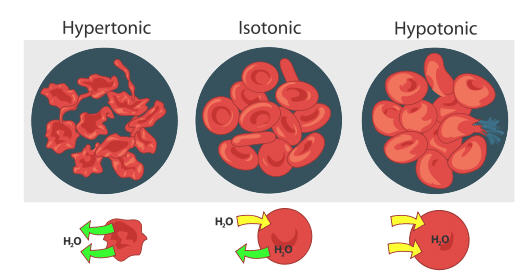
Osmosis is the diffusion of water molecules beyond a semipermeable membrane from an expanse of lower concentration solution (i.e., higher concentration of water) to an expanse of higher concentration solution (i.east., lower concentration of water). Water moves into and out of cells by osmosis.
- If a cell is in a hypertonic solution, the solution has a lower water concentration than the cell cytosol, and water moves out of the cell until both solutions are isotonic.
- Cells placed in a hypotonic solution volition take in water across their membranes until both the external solution and the cytosol are isotonic.
A cerise blood cell will swell and undergo hemolysis (outburst) when placed in a hypotonic solution. When placed in a hypertonic solution, a blood-red blood cell will lose water and undergo crenation (shrivel). Animal cells tend to exercise best in an isotonic surround, where the flow of water in and out of the cell is occurring at equal rates.
Diffusion
Passive transport is a way that small molecules or ions move across the jail cell membrane without input of energy by the cell. The three main kinds of passive transport are diffusion (or simple diffusion), osmosis, and facilitated diffusion. Unproblematic diffusion and osmosis exercise not involve transport proteins. Facilitated diffusion requires the assistance of proteins.
Improvidence is the movement of molecules from an area of loftier concentration of the molecules to an area with a lower concentration. For jail cell transport, improvidence is the movement of small molecules across the prison cell membrane. The difference in the concentrations of the molecules in the two areas is called the concentration gradient. The kinetic free energy of the molecules results in random move, causing diffusion. In elementary improvidence, this process proceeds without the aid of a send protein. Information technology is the random motion of the molecules that causes them to move from an surface area of high concentration to an expanse with a lower concentration.
Diffusion volition proceed until the concentration gradient has been eliminated. Since improvidence moves materials from an expanse of higher concentration to the lower, it is described as moving solutes "down the concentration gradient". The end outcome is an equal concentration, or equilibrium, of molecules on both sides of the membrane. At equilibrium, movement of molecules does not stop. At equilibrium, at that place is equal movement of materials in both directions.
Non everything can brand it into your cells. Your cells accept a plasma membrane that helps to baby-sit your cells from unwanted intruders.
The Plasma Membrane and Cytosol
If the exterior environment of a cell is water-based, and the within of the jail cell is also mostly water, something has to make sure the cell stays intact in this environment. What would happen if a cell dissolved in h2o, like sugar does? Obviously, the cell could non survive in such an surround. So something must protect the cell and let information technology to survive in its water-based surroundings. All cells have a bulwark effectually them that separates them from the environment and from other cells. This barrier is called the plasma membrane, or cell membrane.
The Plasma Membrane
The plasma membrane (come across effigy below) is made of a double layer of special lipids, known as phospholipids. The phospholipid is a lipid molecule with a hydrophilic ("water-loving") head and two hydrophobic ("h2o-hating") tails. Because of the hydrophilic and hydrophobic nature of the phospholipid, the molecule must be bundled in a specific blueprint as only certain parts of the molecule tin physically be in contact with water. Call up that there is water outside the cell, and the cytoplasm inside the jail cell is mostly h2o as well. And so the phospholipids are bundled in a double layer (a bilayer) to proceed the cell separate from its surround. Lipids practice non mix with water (remember that oil is a lipid), so the phospholipid bilayer of the cell membrane acts as a barrier, keeping water out of the cell, and keeping the cytoplasm inside the cell. The cell membrane allows the cell to stay structurally intact in its water-based surround.
The function of the plasma membrane is to control what goes in and out of the cell. Some molecules tin can go through the cell membrane to enter and get out the cell, but some cannot. The cell is therefore non completely permeable. "Permeable" means that anything can cross a barrier. An open up door is completely permeable to anything that wants to enter or exit through the door. The plasma membrane is semipermeable, meaning that some things can enter the cell, and some things cannot.
Molecules that cannot easily pass through the bilayer include ions and small hydrophilic molecules, such equally glucose, and macromolecules, including proteins and RNA. Examples of molecules that tin easily diffuse across the plasma membrane include carbon dioxide and oxygen gas. These molecules diffuse freely in and out of the cell, forth their concentration gradient. Though h2o is a polar molecule, it tin also diffuse through the plasma membrane.

Cytosol
The within of all cells likewise contain a jelly-like substance called cytosol. Cytosol is composed of h2o and other molecules, including enzymes, which are proteins that speed up the cell's chemical reactions. Everything in the cell sits in the cytosol, like fruit in a Jell-o mold. The term cytoplasm refers to the cytosol and all of the organelles, the specialized compartments of the cell. The cytoplasm does not include the nucleus. As a prokaryotic cell does non have a nucleus, the DNA is in the cytoplasm.
Contributors and Attributions
-
Allison Soult, Ph.D. (Department of Chemistry, University of Kentucky)
Source: https://chem.libretexts.org/Courses/University_of_Kentucky/UK%3A_CHE_103_-_Chemistry_for_Allied_Health_(Soult)/Chapters/Chapter_8%3A_Properties_of_Solutions/8.4%3A_Osmosis_and_Diffusion

Post a Comment for "what happens to a cell in a hypertonic solution?"